Where to buy a hydraulic pump for a refuse lorry?
The simplest method is to contact the manufacturer of the machine (refuse lorry) and provide the machine number along with the part that requires replacement. This information should be found in the manual (the spare parts list). However, this is often the most expensive option, and you may need to wait several weeks for the pump. In such a case, we recommend contacting our hydraulic power specialists.
How can you find the original hydraulic pump or its replacement?
You can use the search engine in our online shop. Simply enter the pump code in the search box or open the Refuse Lorry Pumps category. If the code is not in the shop, you can contact us via the contact form.
 Searching for pumps on the hektos.eu website
Each component of the hydraulic system drive (pump, motor, valves, filters) should have a nameplate mounted on its body. The name of the manufacturer and the code on the plate make it much easier to identify the pump, which is one of the first steps in selecting a replacement. Additionally, photos of the entire pump are also helpful. You can send the photos and the pump code to our specialists, who will check the pump's specifications and installation dimensions. Based on this information, they will suggest a new pump. The installation of the hydraulic system in refuse lorries is often constrained by limited space, so finding the code on the hydraulic pump will likely require disassembly of the pump.
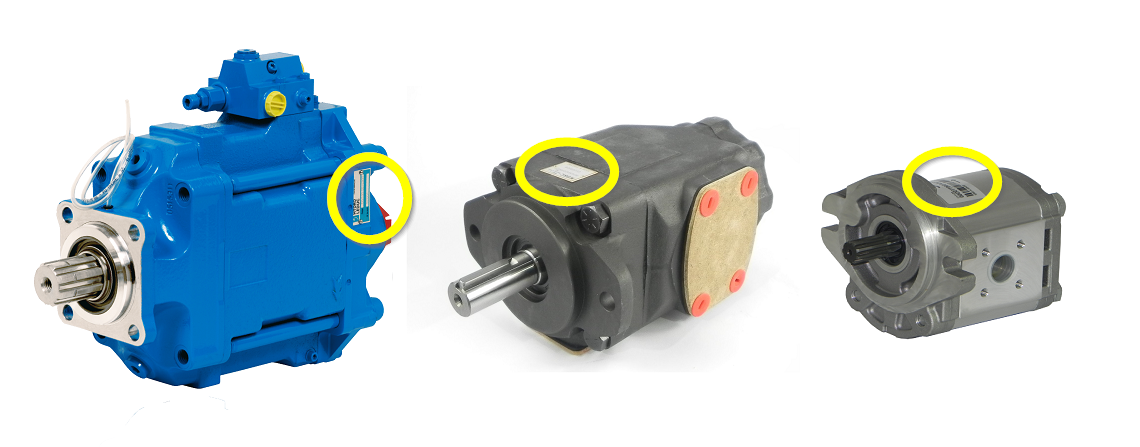 Location of name plates on pumps (from left to right): piston, vane and gear pumps
Identification of vane pump cartridges
We have added a feature to the website: instructions for identifying the inserts of vane pumps, which are often installed in refuse lorry. The manual contains four steps to identify the cartridges and can be downloaded via this link: Vane pump cartridges identification.
What types of hydraulic pumps are fitted to refuse lorries? How much does a new refuse lorry pump cost?
The most common pumps in refuse lorries are vane and piston pumps. Additionally, piston pumps may be available in versions with drive transmission to the gear pump. Gear and vane pumps in refuse lorries are fixed displacement pumps, while piston pumps can be either fixed or variable displacement. The most commonly used controllers in variable displacement pumps are the LS (load sensing) or PC (pressure compensator) controllers.
If the vane pump body and shaft are undamaged, typically, it's sufficient to replace only the cartridges and seals, which significantly reduces repair costs. For piston pumps, the cost of replacing parts (e.g., pistons) is often comparable to that of purchasing an entirely new pump. Gear pumps are commonly employed in hydraulic systems and are typically the least expensive to replace. Prices for new refuse lorry pumps can be found in the Refuse lorry pumps category.
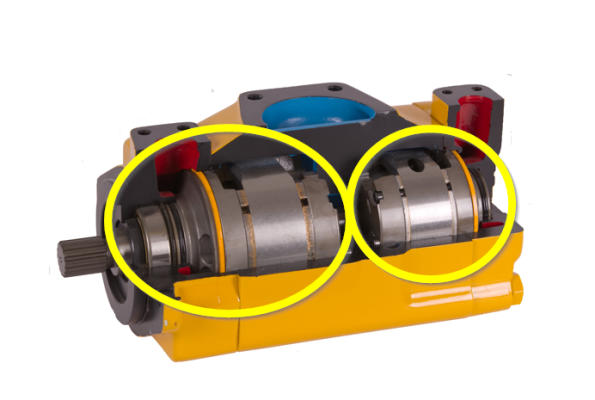
Cartridges in a double-flow vane pump
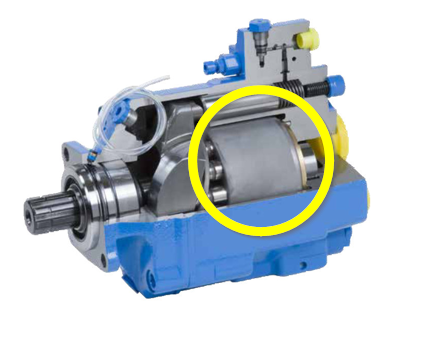
Cylinder barrel with pistons in a variable displacement piston pump
How to prevent hydraulic pump failures in refuse lorries?
Firstly, ensure that the hydraulic oil within the hydraulic system is clean and that you do not exceed the maximum operating parameters of the pump. Each hydraulic system should be equipped with oil filters tailored to the components (pumps, valves, motors, cylinders, etc.) installed within that system. Return filters are most commonly used, but pressure filters are also necessary for proportional hydraulics. Concerning the pumps specifically, manufacturers typically specify the required minimum filtration classes according to the ISO, NAS, or SAE scale in their catalogues:
- for Hydro Leduc piston pumps, the filtration class is 20/18/15 according to ISO/DIS 4406;
- for B&C vane pumps, the filtration class is 18/14 according to ISO/DIS 4406;
- for B&C gear pumps, the filtration class is 23/20 at operating pressure above 150 bar and 26/23 at operating pressure up to 150 bar according to ISO/DIS 4406.
Naturally, it's essential to utilise appropriate hydraulic oil with the correct viscosity:
- for Hydro Leduc piston pumps, HLVP oil with a viscosity ranging from 10 to 400 cSt is recommended (with an optimal viscosity range of 20-30 cSt);
- for B&C vane pumps, the recommended viscosity for mineral oils ranges from 10 to 2000 cSt (with an optimal viscosity range of 10-108 cSt);
- for B&C brand gear pumps, the recommended viscosity is between 15 to 92 cSt.
The maximum operating parameters of a specific pump model can also be found in the catalogues of pump manufacturers. Frequently, these parameters depend on the size of the pump. If there are any uncertainties regarding the maximum continuous working pressure or flow rate, we recommend contacting our specialists via the contact form.
 is a brand of
